
What the 2027 deadline actually requires
From 1 January 2027, every domestic dwelling in Queensland must have interconnected photoelectric smoke alarms installed in every bedroom, in every hallway that connects bedrooms to the rest of the house, and on every storey.
This is the final stage of a change that has been rolling out since 2017. New builds and substantially renovated homes were captured first. From 1 January 2022, any home being sold or leased had to comply before the transaction went through. What lands in 2027 is the rest: owner occupied houses, townhouses and units that have not been sold, leased or renovated in that window.
If you have lived in your Brisbane home since before 2022 and have not touched the alarms, you are almost certainly in the group this deadline applies to.
The requirements came out of the Slacks Creek house fire in 2011, which killed eleven people including eight children. The provisions now sit in the Fire Services Act 1990 and the Building Fire Safety Regulation 2008.
What makes a smoke alarm compliant
A compliant alarm is photoelectric, interconnected with every other required alarm in the home, less than ten years old, and marked as meeting Australian Standard AS 3786:2014.
Four things have to be true at once:
Photoelectric sensor. The alarm detects visible smoke particles. Ionisation alarms do not meet the standard and cannot be used, even if you installed one last month.
Interconnected. Every required alarm in the house must be linked, so that when one is triggered they all sound. This can be done with wiring or wirelessly. In an existing home, wireless interconnection is usually the practical option because it avoids opening up ceilings.
Correct power source. Either hardwired to mains with a backup battery, or powered by a sealed, non removable ten year battery. If the alarm you are replacing was hardwired, the replacement must also be hardwired. You cannot downgrade a wired alarm to a battery one.
Under ten years old. Alarms have a manufacture date printed on them. Once an alarm hits ten years from that date it must be replaced, regardless of whether it still beeps when you press the test button.
How to check whether your alarms already comply
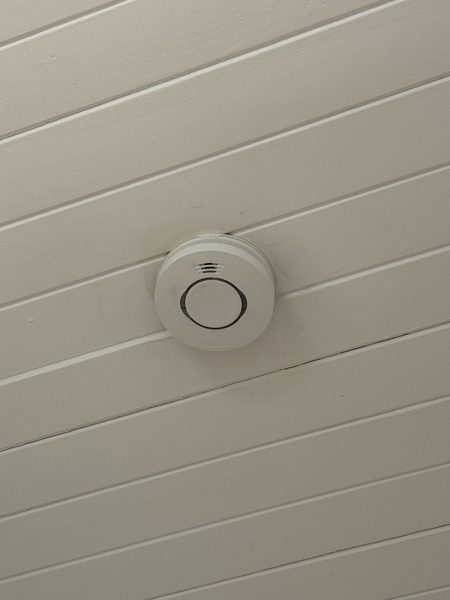
Take the alarm off the ceiling and read the back of it. That is where the answer is.
You are looking for three things. First, the words “photoelectric” or a marking showing AS 3786:2014. If it says ionisation, or shows a radiation symbol, it has to go. Second, the manufacture date. If it is more than ten years old, it has to go regardless. Third, whether it is linked to the others.
Testing interconnection is straightforward. Hold the test button on one alarm and get someone to stand at the far end of the house. If every alarm sounds, they are interconnected. If only the one in your hand sounds, they are not, and the house does not comply.
Most Brisbane homes we open up fail on interconnection rather than on the alarm type. People have replaced individual alarms over the years as they aged, and ended up with four perfectly good photoelectric alarms that have no idea the others exist.
How many alarms you need and where they go
One in every bedroom, one in every hallway that connects bedrooms to the rest of the house, and at least one on every storey.
If a storey has no bedroom on it, you still need an alarm on that level, positioned on the most likely path you would take to get out of the house.
For a typical three bedroom single storey Brisbane home, that usually works out at four alarms: three bedrooms plus the hallway. A four bedroom two storey house is commonly six or seven. A one bedroom unit is often two.
Placement matters as much as the count. Alarms cannot go too close to ceiling fans, air conditioning vents or light fittings, because moving air pushes smoke away from the sensor and stops it doing its job. Corners are also a problem, because air sits still there. This is the part people get wrong when they install alarms themselves, and it is the reason a compliant looking house can still fail.
Do you need an electrician
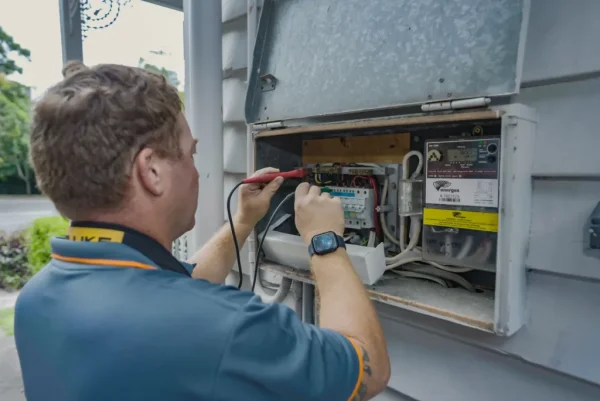
If the alarms are hardwired, yes. Hardwired smoke alarm work is electrical work, it is restricted to licensed electricians in Queensland, and it must be issued with a Certificate of Testing and Compliance under section 227 of the Electrical Safety Regulation 2013.
If your existing alarms are battery only and you are replacing them with sealed ten year battery alarms that interconnect wirelessly, you are not legally required to use an electrician.
The practical argument for using one anyway is placement and evidence. An electrician will get the positions right against the regulation rather than against a guess, and you will end up with documentation showing the house complies. That paperwork matters if you sell, if you convert the house to a rental, or if you ever have to talk to an insurer about a fire.
If your switchboard is older and you are moving to hardwired alarms, it is worth having the board looked at during the same visit. Adding a circuit to a board with ceramic fuses and no safety switches is often the point where a switchboard upgrade stops being optional.
If you rent your property out
Rental properties have had to comply since 1 January 2022, so this is not new for landlords. What is easy to miss is the ongoing obligation: alarms must be tested and cleaned within thirty days before the start of any new tenancy and before any renewal, and at least once every twelve months.
If you are selling, the obligation sits with you as seller, and you declare compliance on the Form 24 as part of the transfer. Arrange it before you list. Discovering a non compliant house between contract and settlement is the single most avoidable delay in a Queensland sale.
FAQ
Can I install interconnected smoke alarms myself? Only if they are battery powered and wirelessly interconnected. Hardwired smoke alarm work is electrical work and is restricted to licensed electricians in Queensland. Even for battery alarms, placement rules are specific and getting them wrong means the house does not comply.
What happens if my home is not compliant by 1 January 2027? Failing to install compliant alarms is an offence under the Fire Services Act 1990 and penalties can apply. The larger practical risks are at sale, at the start of a tenancy, and in any insurance claim following a fire.
Do units and townhouses have to comply? Yes. The requirement covers all existing private homes, townhouses and units. Body corporate arrangements vary on who arranges the work, so check with your body corporate before booking anything.
My alarms are only three years old. Do I still need to do anything? Possibly. Age is only one of four tests. If those alarms are ionisation type, or if they are not interconnected with each other, the home does not comply regardless of how new they are.